
Why Concrete Settles or Becomes Uneven in Jacksonville, FL
What Uneven & Sinking Concrete Can Reveal About Support, Drainage & Movement
A driveway, patio, walkway, slab, or other exterior concrete surface can become uneven when the support beneath one area changes relative to the surrounding sections. The visible result may be a sunken panel, raised joint, tilted slab, new low spot, exposed edge, or noticeable difference in elevation between adjoining sections.
Uneven concrete does not always mean that the lower-looking section is the only area that moved. One section may have settled, another may have lifted, or several connected surfaces may have changed differently over time. Cracking, standing water, erosion, gaps beneath slab edges, landscaping, drainage changes, utility work, and adjoining hardscape can provide useful context.
Understanding what moved, where the movement occurred, and what may have changed beneath or around the concrete is more useful than assuming every uneven surface needs the same repair.
Request an Estimate
If settlement, sinking, uneven joints, tilted concrete, cracking, or changing elevations are affecting a driveway, patio, walkway, slab, or other exterior concrete area, include enough information to show the condition clearly.
Helpful details include where the elevation difference appears, approximately how long it has been noticeable, whether the movement appears to be changing, whether cracking or standing water is present, and whether drainage, landscaping, irrigation, utility work, or adjoining surfaces have recently changed.
Have photos, drawings, or project notes? You can attach them through the form or send additional details to
Thank you. Your project request has been submitted. A local concrete contractor serving your area may contact you about the project.
Please try again later.
Your information may be shared with a local concrete service provider to respond to your request.
Why Does Concrete Settle or Become Uneven?
Concrete flatwork depends on reasonably consistent support beneath the slab. When the supporting ground, fill, or base changes more in one area than another, sections can lose elevation or move differently from adjoining concrete.
More than one condition may be involved, which is why settlement should be considered together with the surrounding grade, drainage, slab edges, joints, cracks, and property history.
Uneven or Inadequate Base Preparation
Concrete placed over material that was not prepared or compacted consistently can have different levels of support beneath different parts of the slab.
If one area compresses more than another over time, the concrete above it may drop relative to the surrounding surface. The practical effect can depend on slab size, intended use, vehicle or equipment loading, drainage, and how the adjoining sections were prepared.
Erosion & Loss of Support Beneath the Slab
Water moving beside, through, or beneath a concrete area can remove or redistribute supporting material.
When enough material is lost, part of the slab may no longer have the same support as the surrounding concrete. The affected section can settle, tilt, crack, or develop a visible gap near an edge.
Repeated runoff, washed-out soil, exposed slab edges, or new low areas can be useful signs that the support condition deserves attention.
Previously Disturbed Ground, Fill & Utility Trenches
Not every area beneath existing concrete has the same history.
Utility trenches, earlier excavation, removed landscaping, additions, previous structures, driveway widening, filled areas, and other property work can leave sections with different support or compaction.
Settlement may therefore follow a narrow trench, appear beside an addition, develop near a utility route, or occur where a slab crosses between differently prepared areas.
Changing Moisture, Runoff & Drainage Conditions
Changes in water movement can affect the material supporting or bordering concrete.
Roof runoff, irrigation, repeated rainfall, altered landscape grade, blocked drainage paths, new hardscape, or later property improvements can change how much water reaches a slab edge and where that water travels.
Moisture alone does not prove why concrete settled. The important question is whether the changing water pattern is also affecting support, erosion, grade, or the elevations around the concrete.
Loads & Changes in How the Surface Is Used
A driveway, walkway, patio, and equipment slab do not carry the same loads.
Vehicle traffic, trailers, storage, equipment, sheds, or other changes in use can place greater demand on an area that may already have inconsistent support.
Loading does not automatically create settlement, but it can make an existing weak or poorly supported area more noticeable.
Common Concrete Settlement & Uneven-Slab Patterns
The pattern of movement can provide more useful information than looking only at one crack or low spot.
One Concrete Section Sitting Lower Than the Next
A noticeable step at a joint often becomes visible when one panel loses elevation relative to the adjoining section.
The cause may involve settlement, support loss, erosion, previous site preparation, utility work, or movement in the neighboring section. Whether the difference is stable or increasing also matters.
A Slab Tilting Toward One Edge
Concrete does not always settle evenly.
One side may remain relatively stable while the opposite edge drops, creating a tilted section. This can change drainage, create an uneven transition, or cause water to begin collecting where the surface previously drained.
A New Low Area That Holds Water
Settlement can create a depression that becomes most noticeable after rainfall, irrigation, or washing.
The water shows that the surface elevation has changed, but the underlying cause still needs to be considered. Original slope, surrounding grade, drainage changes, erosion, or settlement may all contribute.
Cracking With Vertical Displacement
A crack becomes a movement issue when one side is visibly higher or lower than the other.
That condition should be considered differently from a narrow crack in otherwise level concrete because settlement, lifting, support loss, erosion, roots, or another site factor may be involved.
Exposed Edges, Gaps or Washed-Out Material
A visible void beneath an edge or missing material beside the slab can indicate that support conditions have changed.
Not every small gap means continued movement is occurring, but exposed support loss provides useful evidence when combined with settlement, cracking, ponding, or erosion.
Several Sections at Different Elevations
When several adjoining panels have different elevations, the condition may extend beyond one isolated low area.
Drainage, grading, previous construction, fill, base preparation, utilities, intended use, and whether the movement is continuing should be considered together.
Where Settled & Uneven Concrete Commonly Appears
Settlement can have different practical consequences depending on the surface and how it is used.
Driveway settlement may appear near garage transitions, joints, widened parking sections, slab edges, street connections, culverts, or areas exposed to repeated vehicle use.
A driveway project should consider the elevation difference together with drainage, vehicle access, base support, cracking, and how the driveway connects with adjoining surfaces.
Patios may become uneven where concrete meets the home, walkways, pool areas, landscape beds, additions, or other hardscape.
Roof runoff, irrigation, changing landscaping, grade adjustments, and differing support conditions can all become relevant when one patio section moves relative to another.
Even relatively small elevation differences can be noticeable along a frequently used pedestrian route.
Walkways may settle near driveway connections, gates, entries, landscape beds, irrigation areas, roots, utility lines, or transitions between differently prepared sections.
Garage slabs, shed slabs, workshop areas, equipment pads, and other concrete slabs should be considered in relation to what they support.
Settlement that affects doors, equipment, drainage, adjoining structures, access, or the intended load may require a different project scope from an isolated walkway panel.
Landscape & Hardscape Transitions
Concrete edges beside lawns, planting beds, pavers, asphalt, pools, curbs, and other hardscape can develop changing support or elevation relationships.
A surface may appear to have “sunk” when another adjoining area has risen, or several surfaces may have moved differently. The wider transition should be considered before assuming which section caused the height difference.
Jacksonville Conditions That Can Influence Concrete Settlement
Jacksonville does not have one universal settlement condition. Support beneath exterior concrete varies with the original site, property development, fill, grading, drainage, construction history, landscaping, and later changes.
The useful local question is whether conditions around the actual property have changed enough to affect support beneath or beside the concrete.
Seasonal Rainfall, Runoff & Edge Support
Jacksonville receives frequent rainfall during the wetter part of the year, and runoff can become concentrated around driveways, patios, walkways, and other hardscape.
Rainfall itself does not mean concrete will settle. The concern is where water repeatedly reaches vulnerable slab edges, carries away supporting material, changes the surrounding grade, or exposes an existing support problem.
Settlement that appears with washout, recurring ponding, exposed edges, or changing drainage deserves to be considered together with the water path around the property.
Sandy, Filled & Disturbed Residential Ground
Many Jacksonville-area properties have sandy soils, but actual support conditions can vary substantially between sites and even across the same lot.
Construction traffic, fill, previous excavation, utility trenches, demolished improvements, landscape work, and later additions can create sections of ground with different compaction or drainage characteristics.
The condition beneath the affected slab matters more than assuming every Jacksonville property has one identical soil profile.
Relatively Flat Grades & Small Elevation Changes
Across relatively flat properties, small elevation differences can noticeably change how water moves.
A section that settles only enough to create a new low point may begin holding runoff or redirecting water toward a joint, garage, entry, landscape bed, or adjoining slab.
That relationship can also work in reverse: changing drainage or erosion may contribute to support loss before the visible settlement becomes obvious.
Landscaping, Irrigation & Roof Runoff
Concrete often sits beside lawns, trees, planting beds, irrigation lines, downspouts, gutters, and landscape edging.
Changes to those features can alter where water reaches the slab or how the surrounding soil is supported. Irrigation leaks, redirected roof water, raised landscape beds, removed vegetation, or later grading can all change conditions around concrete that has been in place for years.
Utility Work, Additions & Connected Hardscape
Driveway extensions, new patios, utility trenches, fences, additions, pool work, drainage improvements, and other property changes can alter support or water movement around existing concrete.
Settlement near a transition should therefore be considered in relation to both the older and newer work rather than treating each surface as completely independent.
Driveway Connections, Culverts & Right-of-Way Areas
Settlement near a driveway approach, sidewalk, culvert, ditch, or street connection can involve more than the private concrete surface.
Where corrective work extends into a public right-of-way or another regulated area, jurisdiction and permit requirements may need to be confirmed before the work is defined.
When Should Settled or Uneven Concrete Be Looked At More Closely?
A small height difference does not automatically mean an entire driveway, patio, walkway, or slab has failed.
Closer review becomes more useful when:
- the elevation difference appears to be increasing;
- several adjoining sections have moved;
- one side of a crack sits noticeably higher or lower than the other;
- standing water has developed where the surface previously drained;
- soil or base material is washing away from a slab edge;
- a visible gap or unsupported area appears beneath the concrete;
- movement affects a garage, door, gate, step, equipment area, or other transition;
- an uneven section interferes with normal walking or vehicle use;
- a crack or repair repeatedly returns in the same area;
- a previously corrected section begins moving again;
- the condition developed after drainage, landscaping, utility, excavation, or other property work.
These signs do not determine the repair by themselves.
They indicate that the concrete movement, surrounding support, drainage, intended use, adjoining surfaces, and extent of the affected area should be considered before selecting the project scope.
Partial replacement may make sense when one or several sections have moved significantly while adjoining concrete remains suitable.
Removing the failed area also creates an opportunity to review the support, grade, drainage, and transitions beneath that section before replacement concrete is placed.
Can Settled or Uneven Concrete Be Corrected?
Often, but the appropriate approach depends on why the concrete moved, how much of the surface is affected, whether the slab itself remains suitable, and whether the condition beneath or around it can be corrected.
Address Drainage, Erosion or Support Loss Where Relevant
Slab Leveling or Lifting Where Appropriate
If runoff, edge washout, or another water-related condition is removing support, correcting only the visible elevation may leave the contributing problem in place.
Drainage routes, surrounding grade, slab-edge support, and adjoining property conditions may therefore need to be considered as part of the project.
Some settled slabs that remain otherwise serviceable may be candidates for a leveling or lifting approach.
Suitability depends on the slab condition, amount and pattern of settlement, support beneath the slab, drainage, surrounding elevations, access, intended use, and whether the contributing condition can be addressed.
Raising a slab does not automatically correct poor drainage, erosion, unsuitable fill, or another underlying support problem.
Localized Concrete Repair
Selective Section Replacement
Settlement can also create cracking, damaged joints, broken edges, surface deterioration, or other localized damage.
Where the surrounding concrete remains suitable, repair or resurfacing may form part of the project, but surface work should account for the movement that contributed to the visible damage.
Partial replacement may make sense when one or several sections have moved significantly while adjoining concrete remains suitable.
Removing the failed area also creates an opportunity to review the support, grade, drainage, and transitions beneath that section before replacement concrete is placed.
Broader Replacement
More extensive replacement becomes relevant when settlement affects multiple sections, support correction is widespread, required elevations need substantial changes, deterioration is extensive, or the existing layout no longer works well for the property.
The important distinction is between correcting the visible elevation and addressing the condition that allowed the movement to develop.
How to Reduce Avoidable Concrete Settlement
No exterior slab should be described as permanently immune from movement. Property conditions can change after installation.
Good preparation, support and drainage can nevertheless reduce avoidable settlement problems.
Prepare & Compact the Supporting Area
Concrete should begin with reasonably uniform support suited to the intended use.
Excavation, grading, fill placement, compaction, and base preparation should reflect the actual ground conditions, slab type, drainage, and expected loading rather than treating every concrete project the same way.
Plan Drainage Before Concrete Is Placed
Surface slope, roof runoff, adjoining hardscape, landscaping, irrigation, and the available drainage path should be considered before placement.
Keeping concentrated runoff away from vulnerable slab edges can reduce avoidable erosion and support loss.
Coordinate Utility & Property Work
Utility trenches, additions, irrigation work, landscaping, driveway widening, and other property improvements can disturb ground beside or beneath existing concrete.
Where later work crosses or borders a concrete area, restoring appropriate support and drainage should be part of the project.
Protect Slab Edges & Surrounding Grade
Changes next to concrete can matter almost as much as changes directly beneath it.
Washout, erosion, excavation, landscape removal, or changing grade beside slab edges should be addressed before unsupported areas become more extensive.
Watch for Early Elevation & Drainage Changes
New ponding, widening gaps, exposed edges, changing joints, recurring cracks, or small differences in slab elevation can provide early evidence that conditions around the concrete are changing.
Monitoring cannot stop active settlement, but recognizing the pattern early can make it easier to distinguish a localized issue from broader movement.
Helpful Resources for Settled & Uneven Concrete
Once settlement is recognized, the next useful question usually involves the condition of the existing concrete, drainage, repair scope, replacement, installation, or project cost.

If settlement has contributed to cracking, damaged joints, broken edges, worn areas, or localized deterioration, review when repair or resurfacing may still be practical for concrete that remains suitable.

If one or several sections have moved, compare repair, resurfacing, selective replacement, and full replacement to understand how the extent of settlement and remaining concrete condition can change the project scope.
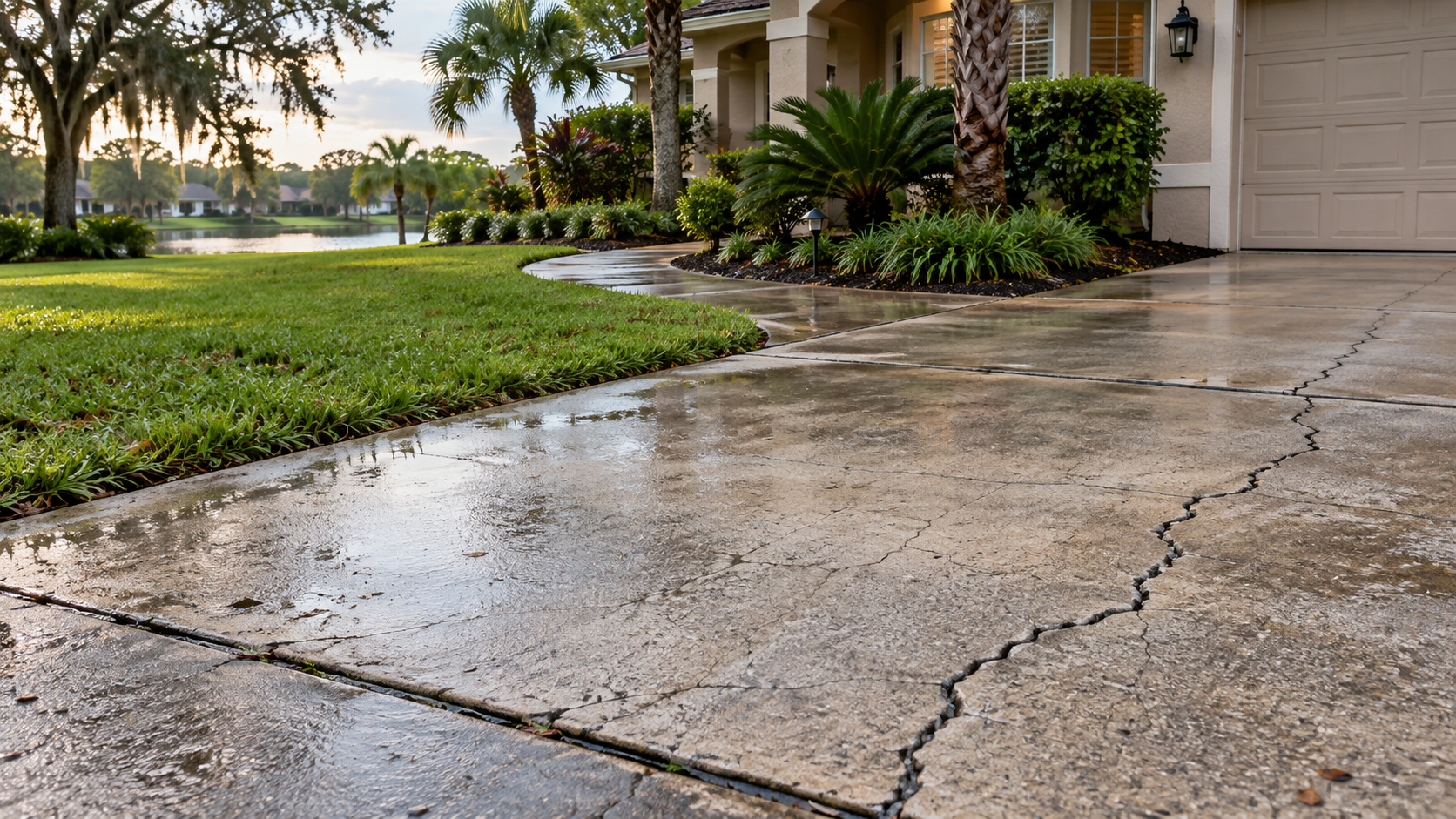
Settlement and cracking often appear together, but the crack pattern can provide additional context about movement, support, joints, restraint, and surrounding conditions.

If settlement has created low spots—or runoff and erosion may have contributed to support loss—review how drainage, slope, roof water, landscaping, and surrounding grade interact with concrete.

If partial or full replacement is becoming the likely direction, review how site preparation, grading, base support, drainage, placement, jointing, finishing, and curing fit into a new installation.

Settlement can lead to very different project scopes, from localized corrective work to selective or broader replacement. Review the main preparation, access, drainage, removal, finish, and site-condition factors that can affect pricing.
Request a Concrete Estimate for Settled or Uneven Concrete in Jacksonville
Understanding why a concrete surface has moved can help narrow the next step, but the appropriate project scope depends on the actual property.
The amount of settlement, affected area, cracking, drainage, support conditions, previous repairs, intended use, access, adjoining hardscape, and whether the movement appears to be continuing can all influence the project.
Concrete services are available throughout Jacksonville and nearby Northeast Florida communities.
Explore:
Concrete Services in Atlantic Beach, Concrete Services in Fleming Island, Concrete Services in Green Cove Springs, Concrete Services in Jacksonville Beach, Concrete Services in Middleburg, Concrete Services in Neptune Beach, Concrete Services in Nocatee, Concrete Services in Oakleaf Plantation, Concrete Services in Orange Park, Concrete Services in Ponte Vedra Beach, Concrete Services in St. Augustine and Concrete Services in St. Johns
👉 Explore our full Jacksonville concrete service areas page to find your community.
Submit your project details to request an estimate.
Concrete Settlement & Uneven-Slab FAQs for Jacksonville Properties
What causes a concrete slab to sink?
Concrete can sink when the supporting material beneath part of the slab compresses, settles, erodes, washes out, or no longer provides the same support as the surrounding area. Uneven compaction, disturbed fill, utility trenches, drainage changes, edge erosion, and other site conditions may also contribute.
Does uneven concrete always mean the lower section has settled?
Concrete can sink when the supporting material beneath part of the slab compresses, settles, erodes, washes out, or no longer provides the same support as the surrounding area. Uneven compaction, disturbed fill, utility trenches, drainage changes, edge erosion, and other site conditions may also contribute.
Can poor drainage cause concrete to settle?
Drainage can contribute when repeated runoff, erosion, washout, or changing moisture conditions affect the supporting material beneath or beside a slab. Where settlement appears together with standing water or exposed edges, both the drainage pattern and the concrete movement should be considered.
Can settled concrete be leveled instead of replaced?
Sometimes. Certain slabs that remain otherwise suitable may be candidates for a leveling or lifting approach. The concrete condition, amount of movement, underlying support, drainage, access, surrounding elevations, and intended use all influence whether leveling, localized repair, selective replacement, or broader replacement is appropriate.
Does resurfacing fix a settled or uneven slab?
Resurfacing can renew a suitable concrete surface, but it does not restore missing support or correct active movement beneath a slab. Settlement and elevation differences should be addressed before resurfacing is treated as the primary solution.
Why would only one concrete section settle?
Adjoining sections can sit over different support conditions. Differences in fill, compaction, drainage, utility trenches, edge erosion, previous excavation, loading, or property work can allow one section to move while the next remains relatively stable.
Does settled concrete always need to be replaced?
No. Localized settlement may remain suitable for leveling, repair, or selective section replacement when the surrounding concrete remains usable and the contributing condition can be addressed. Broader movement, repeated settlement, widespread deterioration, or extensive support problems may make replacement more practical.
Does uneven exterior concrete mean there is a foundation or sinkhole problem?
Not by itself. Exterior flatwork can become uneven because of localized support loss, fill, erosion, drainage, roots, previous excavation, or other site conditions. Movement involving a building foundation, structural slab, walls, interior floors, or broader structural symptoms is a separate issue and may require evaluation outside an ordinary exterior-concrete project.